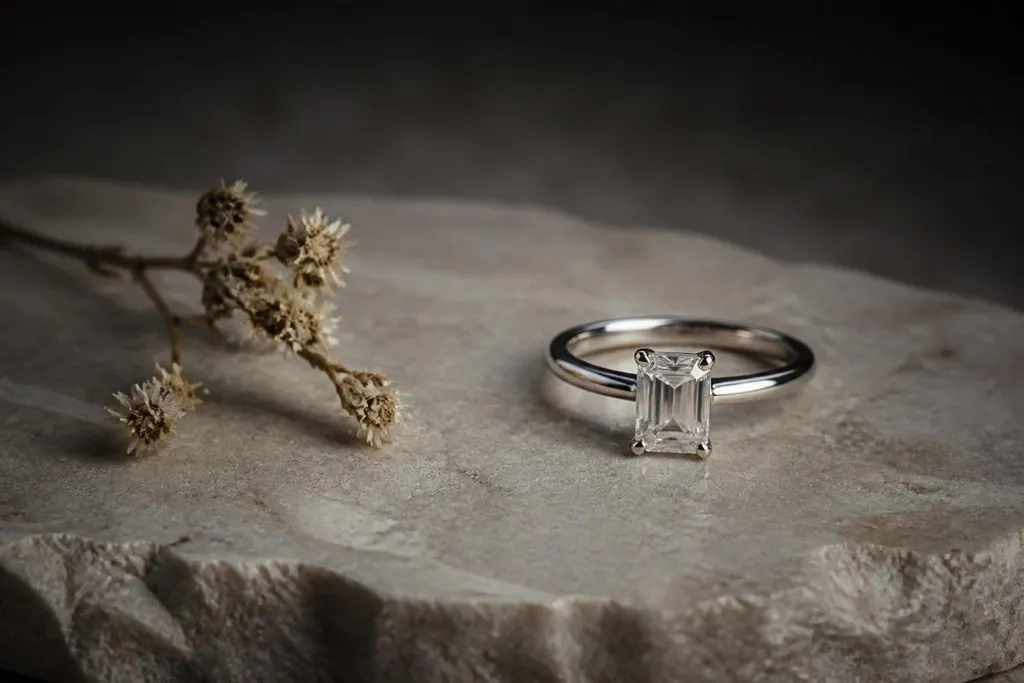
An emerald-cut diamond does not compete for attention in the same way as a brilliant cut. Instead of rapid flashes of sparkle, its long step facets produce broader reflections and a distinctive hall-of-mirrors effect. The result is controlled, architectural and particularly revealing of the diamond itself.
That visual clarity is central to the appeal of beautiful lab diamond emerald cut rings. With their rectangular outlines, cropped corners and precisely ordered facets, emerald-cut lab diamonds reward careful selection. Clarity, symmetry and proportion all play important roles, while the setting determines whether the finished ring feels minimalist, Art Deco-inspired or more contemporary.
Why Clarity Deserves Extra Attention
Emerald cuts have a relatively large, open table and fewer of the small brilliant-style facets that can help disguise internal characteristics in other diamond shapes. As a result, inclusions may be easier to notice.
This does not mean the highest possible clarity grade is automatically necessary. What matters in practical terms is whether any inclusions are visible to the unaided eye and whether they interrupt the clean, reflective appearance that makes an emerald cut distinctive.
Rather than selecting a diamond solely by its grading report, it is worth examining how clear and balanced it appears face-up. Two lab-grown diamonds carrying similar grades can still create different visual impressions depending on the location and nature of their inclusions.
The same principle applies to colour. Because an emerald cut offers broad windows into the stone, subtle differences can sometimes be more apparent than they are in highly scintillating cuts. Metal choice and personal preference should therefore be considered alongside the formal grade.
Proportion and Symmetry Shape the Personality
Emerald-cut diamonds vary considerably in length-to-width ratio. A more elongated stone creates a slender, elegant silhouette, while a shorter rectangle has a stronger, more substantial appearance. There is no single ideal ratio for every wearer. Someone with long fingers may appreciate the pronounced length of an elongated emerald cut, while another person may prefer a broader stone because it provides greater width across the hand.
Symmetry is especially important because the cut is based on straight lines and repeated geometric patterns. Slight inconsistencies in the outline or facet arrangement can be more noticeable than they might be in a shape with busier sparkle.
Carat weight should also be viewed in context. A 2-carat emerald-cut lab diamond may be chosen because its length and surface area create elegant finger coverage, not simply because it is twice the weight of a 1-carat stone. Conversely, a smaller emerald cut can look exceptionally refined when its proportions are paired with a delicate setting.
Choose a Setting That Respects the Geometry
The setting should complement rather than obscure an emerald-cut diamond's distinctive corners and rectangular outline.
A solitaire provides the cleanest interpretation, allowing the symmetry and step facets to remain the focus. Diamond-set shoulders can introduce additional brilliance and create an attractive contrast between the centre stone's broad flashes and the finer sparkle of smaller brilliant-cut diamonds.
Halo designs provide a more decorative alternative, increasing the ring's overall footprint while reinforcing its geometric outline. For a subtler treatment, a hidden halo can add detail beneath the centre stone without significantly changing its appearance from above.
The cropped corners require secure setting, so claw placement deserves attention. Well-positioned claws protect the diamond while preserving as much of its outline as possible.
Metal, Band Width and Everyday Wear
Metal can noticeably change the character of an emerald-cut ring. Platinum and white gold emphasise its cool, crisp geometry, while yellow gold creates a warmer contrast that can give the design a stronger vintage influence. Rose gold offers a softer interpretation.
Band width matters as well. A fine band can make the centre diamond appear more prominent, while a broader band provides visual weight that may suit a larger stone.
Setting height should reflect how the ring will actually be worn. An elevated emerald cut can create an impressive side profile, but someone who regularly works with their hands may prefer a lower, more streamlined construction. Wedding-band compatibility should also be considered, particularly if a flush fit is important.
Final Thought
Emerald-cut lab diamond rings are defined less by intense sparkle than by precision. Their beauty comes from clear step facets, balanced symmetry and the interaction of light across broad, ordered surfaces.
Choosing one thoughtfully means looking beyond carat weight. Clarity, dimensions, proportion and setting all contribute to the finished effect. When those elements are carefully balanced, an emerald-cut lab diamond offers a form of elegance that feels confident precisely because it does not need to be overstated.